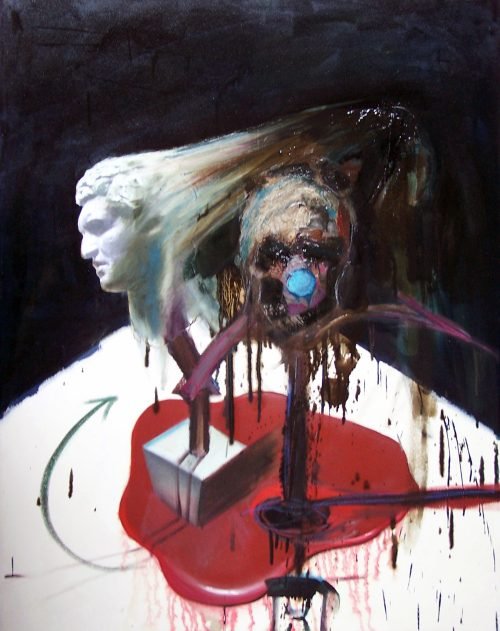
Triadic Structure: The Divided Construct
2009 Italy
Identity is stabilised as multiplicity — a triadic construct held within a single architectural axis.
In 2009, the investigation reaches a point of internal multiplication.
After elevation, compression, and enclosure, the still life no longer negotiates between object and field — it divides itself.
Within Triadic Structure: The Divided Construct, identity is no longer staged through environment, gravity, or containment. It is split and held in simultaneous presence. The composition stabilizes three directional forces within a single vertical system.
The human reference does not appear as portrait.
It appears as structural fracture.
Classical form, distorted mass, and material residue coexist along a central axis. The field remains controlled. The equilibrium persists. Yet within that equilibrium, internal division becomes visible.
This is not fragmentation as collapse.
It is fragmentation as architecture.
The psyche is treated as constructed plurality — sustained within one frame, but never fully reconciled.
Italy remains the ground.
The investigation remains structural.
But here, identity itself becomes the object under examination.
Representative Works (Selection)
The work presented here functions as a structural culmination of the 2009 cycle. Rather than expanding outward into spatial containment or gravitational density, it turns inward — concentrating division within a single compositional axis.
The triadic configuration is not symbolic; it is operative. Multiple identities occupy the same structural system, stabilized through equilibrium of mass, direction, and gesture. Classical reference, contemporary distortion, and material erosion coexist without hierarchy.
This work demonstrates the final evolution of the psychodynamic still life in this early period:
from excavation,
to staging,
to containment,
to compression,
to division.
It does not dramatize fracture.
It organizes it.