
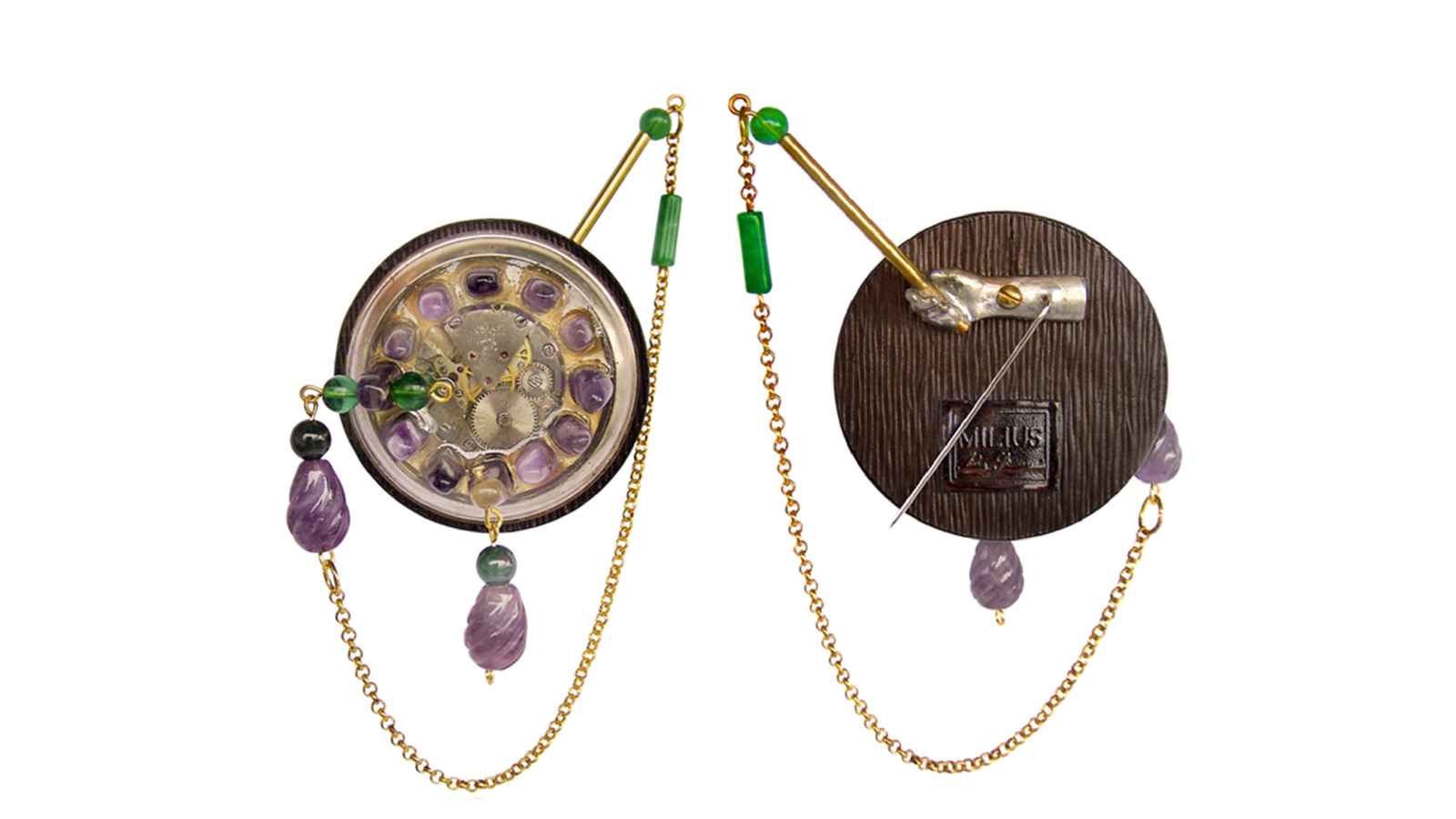

Kings and Pawns – Chapter 1 – PIECE 2 Ascendria
Artist PIN (sculptural-object), applied arts – jewellery design
2013–2014, Florence, Italy
Author: Milan Stamenovic
Handmade, unique piece (one of a kind)
Materials:
Watch mechanism parts, tin elements, brass elements, semi-precious stones (amethyst, quartz), metal chain, resin, plexiglass, gold leaf, leather.
Provenance / status:
All works from the Kings & Pawns chapter are held by the artist.
Availability, acquisition, or institutional loan inquiries are considered upon request.
Ascendria addresses the moment in which ambition begins to reorganize the individual from within. Unlike overt manifestations of power, the work does not depict authority as force, but as internal realignment — a gradual recalibration of priorities, values, and perception.
The object is structured around vertical tension. Elements are suspended rather than fixed, implying upward movement without guaranteeing arrival. Mechanical components — once designed to regulate time — are displaced from function and reassigned as symbols of calculation, patience, and controlled progression. Time here becomes a resource to be managed, withheld, or leveraged.
The dual-sided construction is essential to the work’s meaning. One face reveals a dense constellation of mechanical and mineral elements, suggesting accumulation and strategic layering. The reverse withdraws into reduction, exposing the quieter architecture that supports ascent without spectacle. Together, the two sides articulate a central paradox: elevation requires both visibility and concealment.
Amethyst and quartz introduce a chromatic softness that contrasts with the rigidity of metal. These materials do not romanticize the object; instead, they signal the psychological seduction of advancement — clarity, promise, and the illusion of inevitability. What appears refined is, in fact, precariously balanced.
Within the Kings & Pawns chapter, Ascendria represents a diagnostic state: the early phase of self-positioning within a hierarchy. It is the stage at which power is not yet possessed, but intensely desired — and where the individual begins to reshape themselves to be worthy of it.
As a wearable object, Ascendria functions as a quiet declaration rather than a public emblem. It is carried close to the body, marking the internal acceptance of ascent as necessity, not ambition. The work does not celebrate rise; it examines its cost.