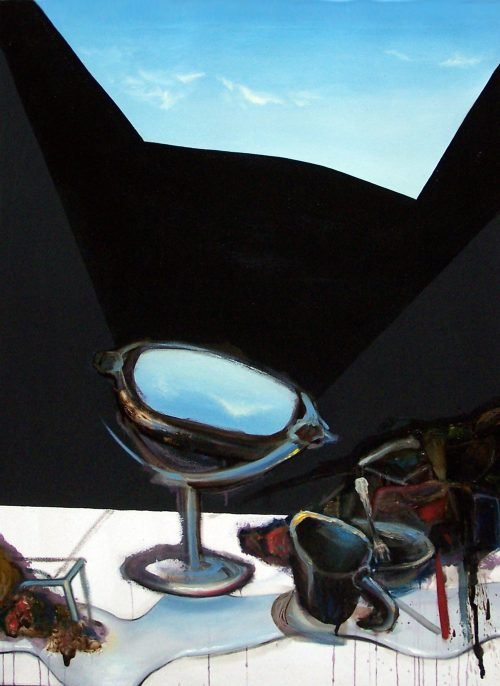
In Il Mattino, the chamber opens to light.
After the enclosed architectures of cognition, the inquiry turns toward diurnal condition — the temporal structuring of interior space. Morning does not dissolve constraint; it clarifies it.
The sky occupies the upper field — pale, luminous, expansive. Yet it is framed by dark, angular walls. The horizon is visible, but it is not freely accessible. The architecture remains operative.
On the lower plane, objects gather: a reflective mirror, a vessel, a fragment, a cube. Liquids pool across the white surface, suggesting both dissolution and renewal. Reflection becomes central. The mirror does not reflect the room — it reflects sky.
Interior consciousness reaches upward.
The composition maintains structural discipline:
black enclosure above, white ground below, objects arranged along a horizontal axis. Gravity persists, but tension softens into suspension. The red vertical accent introduces temporal incision — a mark within the field of day.
If the previous cycle regulated thought through containment, Il Mattino examines awareness as it re-enters light.
Morning is not innocence.
It is recalibration.
The interior remains constructed.
The condition shifts.