With Crisis, language no longer accompanies the image — it becomes structural pressure.
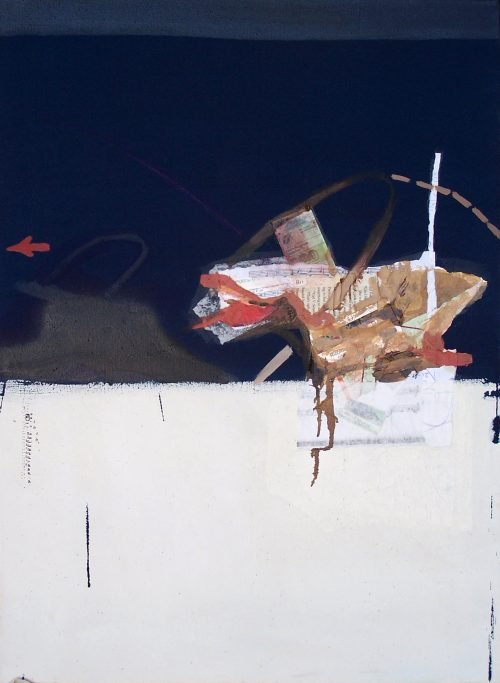
Fragments of musical notation, currency, printed matter, and directional markers are embedded into a sharply divided field. The upper register holds darkness as potential space; the lower plane remains disciplined and exposed. Between them, the constructed cluster operates as a compressed declarative unit — neither narrative nor illustration, but statement.
Here, language is not read.
It is forced into tension.
The red directional arrow, the vertical white bar, the torn printed sheets — all operate as operative signs rather than symbols. They do not describe crisis; they enact it. Meaning is not expanded but tightened.
The still life has now shed interior excavation and theatrical staging. It becomes declarative surface: a site where information collides, fragments resist cohesion, and syntax is held under strain.
The field remains controlled.
The pressure increases.
“The surface does not communicate crisis. It stabilises it as structure.”