Kings and Pawns – Chapter 1 – PIECE 8 Residuum
Artist PIN (sculptural-object), applied arts – jewellery design
2013–2014, Florence, Italy
Author: Milan Stamenovic
Handmade, unique piece (one of a kind)
Materials:
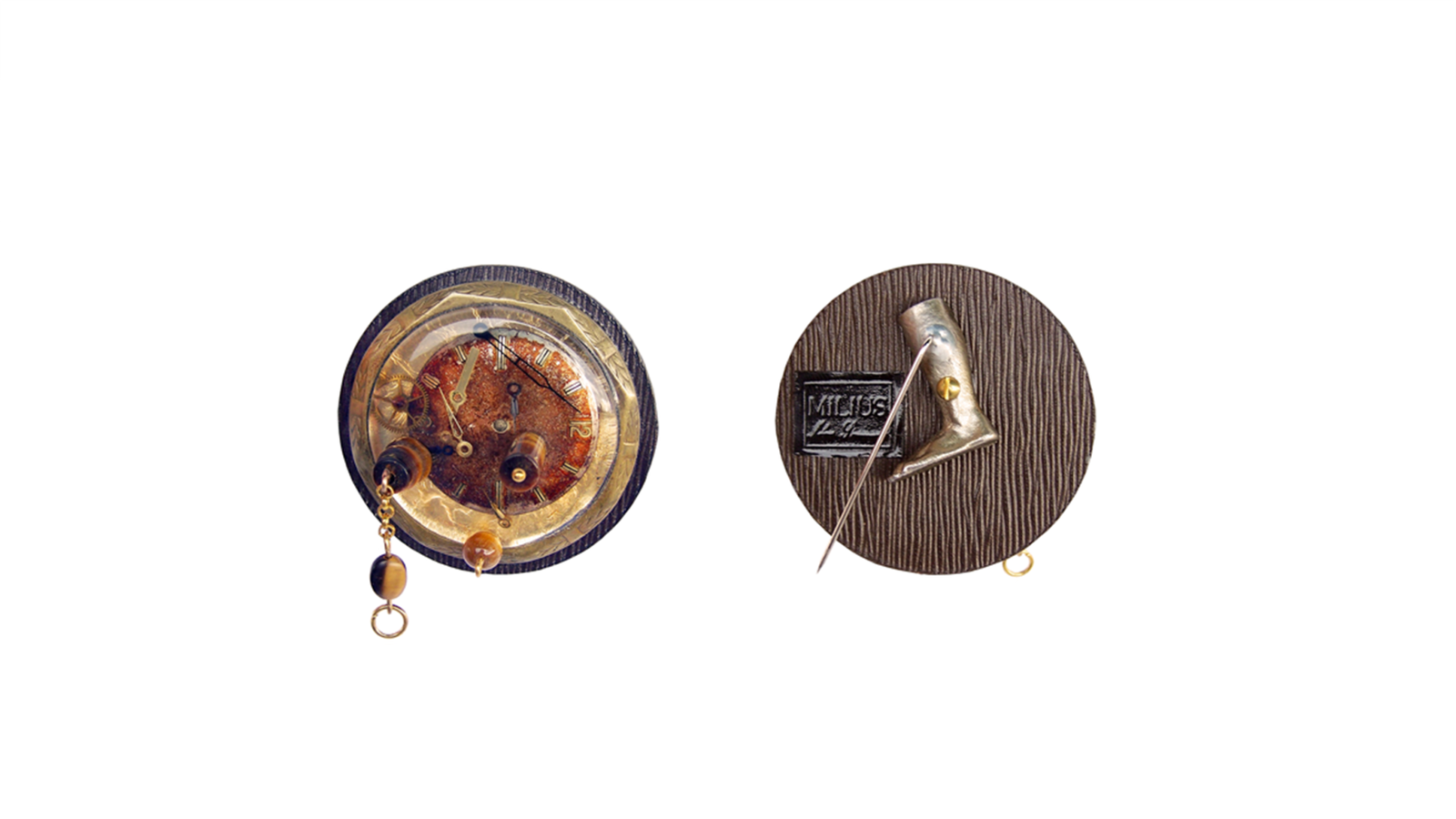
Watch mechanism parts, tin elements, brass elements, semi-precious stone (tiger’s eye), metal chain, resin, plexiglass, 22k gold leaf, leather.
Provenance / status:
All works from the Kings & Pawns chapter are held by the artist.
Availability, acquisition, or institutional loan inquiries are considered upon request.
Residuum constitutes the final condition of Kings & Pawns: not collapse, but aftermath. Where Fracturex records the failure of internal structure, this work observes what remains once power has passed through the body and withdrawn.
The object is reduced in emphasis, yet not emptied. Mechanical elements persist without urgency, detached from the systems they once served. Time is no longer measured, optimized, or monitored; it lingers as presence without demand. The structure does not attempt to restore coherence. It accepts remainder as its state.
Duality here is subdued. One side presents the object in its most diminished configuration, stripped of strategic tension and performative density. The reverse offers no counterargument, only quiet continuation. Together, they articulate a condition beyond ambition, vigilance, or resistance — a state defined by endurance rather than agency.
Material choices reinforce this resolution. Metallic components retain their mass but no longer assert control. Mineral elements appear residual, functioning less as structure than as trace. What once signified intention now records consequence.
Within the diagnostic framework of Kings & Pawns, Residuum marks the point at which hierarchy no longer operates as a force to be navigated. The individual is no longer reshaped by power, but shaped by having survived it. Nothing is repaired. Nothing is redeemed. What remains is the body, carrying evidence.
As a wearable object, Residuum functions as a quiet acknowledgment rather than a statement. It does not demand attention. It does not resolve the chapter. It closes it by refusing continuation — affirming that some systems leave only remainder, and that remainder must be borne.