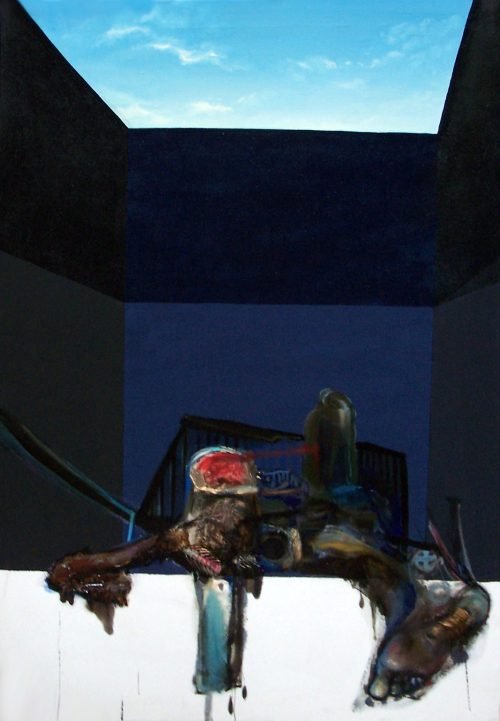
If Il Mattino opens the chamber to light, Il Mezzogiorno stabilises it.
Midday eliminates ambiguity. Shadows retract. Forms are fully declared.
Within the architecture of the diurnal cycle, this work occupies the axis of exposure — the moment when interior condition is no longer veiled by atmosphere. The chamber remains constructed, but illumination becomes uncompromising.
Spatial tension intensifies vertically. The upper field asserts pressure downward; the lower plane receives it without collapse. Objects are no longer emerging — they are fixed, clarified, structurally positioned.
Where morning allowed reflection, midday demands confrontation.
The compositional grammar remains disciplined:
– architectural enclosure,
– horizontal staging line,
– controlled object cluster,
– calibrated chromatic accents.
Yet the light now behaves differently. It does not soften structure — it reveals its severity.
Midday in this cycle is not brightness as comfort.
It is consciousness at full exposure.
The interior does not dissolve into openness.
It holds.
Presence becomes weight.