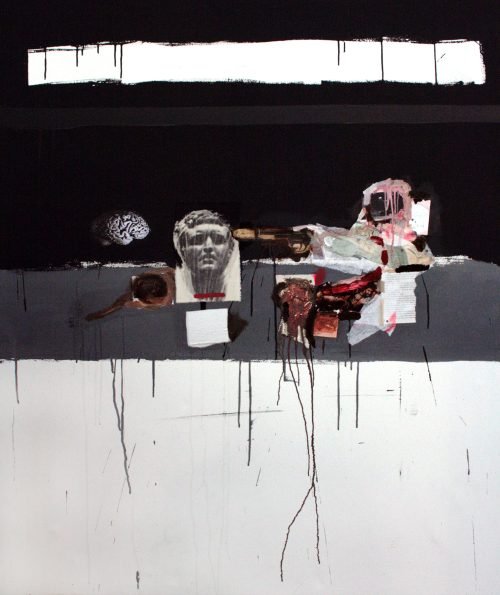
In Still Life Shot I, the still life undergoes a decisive transformation.
The excavation of the object, characteristic of earlier cycles, gives way to confrontation.
The composition is no longer horizontally stabilized. It becomes a staged arena.
The interior is constructed as a site of pressure where object and subject collide within a controlled architectural frame.
Anatomical fragments, sculptural references, and instruments of force occupy the same compositional field. They are not illustrative elements; they function as structural agents. The painted surface absorbs impact while preserving equilibrium.
Here, the psyche is not implied through atmosphere but staged as material presence. The “shot” is neither narrative nor literal — it is compositional rupture. A directional force interrupts stability without dissolving structure.
This painting marks the shift from excavation to exposure:
the still life becomes an operative interior,
and psychological tension is rendered spatial.
Italy remains the ground of execution, yet the inquiry is structural — not geographical. Identity is not depicted. It is constructed under pressure.