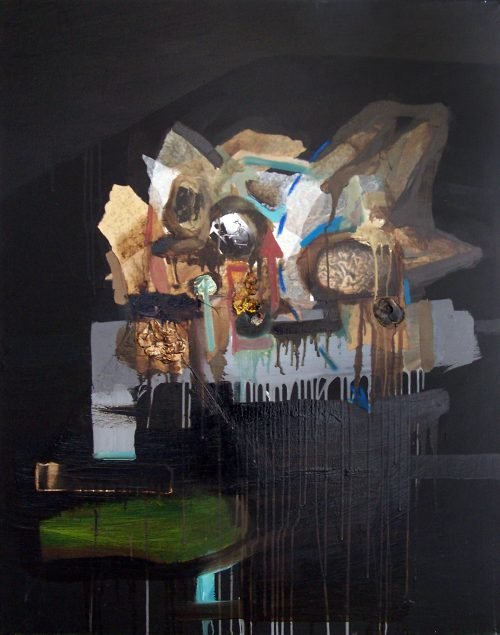
Natura Morta in the Evening marks a decisive recalibration within the 2007–2008 cycle.
If the preceding works excavate the object, here the field thickens. Light shifts. Perception slows. The still life is no longer exposed through incision but altered through atmosphere.
The horizontal equilibrium remains disciplined, yet darkness advances as structural agent. The upper field deepens into opacity while the lower plane sustains material articulation — collage, anatomical fragments, painted interventions, and embedded references coexist under compressed illumination.
Evening is not narrative.
It is perceptual condition.
Forms appear suspended between recognition and withdrawal. The object does not dissolve; it becomes less immediately legible. The surface absorbs light, creating a state in which cognition must adjust before it can operate.
This painting establishes a fundamental premise of the cycle:
that psychological inquiry can be conducted through shifts in luminosity rather than compositional rupture.
Clarity is not lost.
It is delayed.
The work signals the transition from excavation toward altered perceptual architecture — a controlled transformation that prepares the ground for the staged interiors that follow.